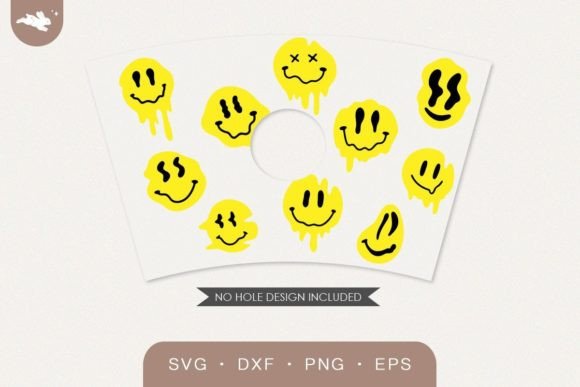
Smiley Face Cup
A Bright, Playful Spark — But Is It Embroidery-Ready?
Let’s be real: I opened the Smiley Face Cup file expecting cheerful simplicity—and got exactly that. A bold, round face with wide eyes, a curved mouth, and clean, closed contours. No internal cut lines, no “hole” design—just one cohesive shape. That tells me it was built for cutting machines first (Cricut, Silhouette), not embroidery machines. But as someone who regularly adapts graphic files for stitch-based work, my instinct was to ask: *Can this hold up under thread?*
First Impressions on Fabric: Mood Meets Mechanics
The Smiley Face Cup radiates upbeat, retro-hippie energy—think sun-drenched festivals, handmade coffee shops, or playful nursery decor. Visually, it’s friendly and legible at a glance. But embroidery isn’t about pixels—it’s about how thread builds form. So I pulled it into my digitizing software and ran a quick simulation on a 4" hoop. What stood out wasn’t charm—it was scale. At full size, the face fills most of a standard tote bag front or sweatshirt chest placement. That’s great for visibility, but risky if you’re stitching on thin cotton tees or baby onesies where bulk matters.
Where It Shines (and Where It Stumbles)
I tested the Smiley Face Cup as an embroidered patch on denim, then as a chest design on a medium-weight unisex sweatshirt. On both, it read clearly—especially with high-contrast thread (navy on cream, yellow on charcoal). The rounded shape translated well into satin stitch outlines and smooth fill areas. No jagged corners. No tiny details begging to vanish in stitching.
But on stretchy fabric? Not ideal. Without careful stabilizer pairing (cutaway + tear-away combo), the smile’s curve distorted slightly on a lightweight jersey tote. And on dark fabric—say, black tea towels—I had to boost stitch density just enough to prevent “shadowing,” where thread gaps let the base show through. That’s not a flaw in the design itself, but a reminder: Smiley Face Cup is a graphic first. It needs thoughtful translation for embroidery.
Real-Life Fit: From Boutique Shelf to Baby Shower Gift
Last week, I used a modified version (simplified eyes, thicker outline) on a set of linen kitchen towels for a local café pop-up. Customers loved the warmth—and more than one asked, “Is that hand-stitched?” That’s the handmade product magic: when a simple shape feels intentional, joyful, and human-made. I’ve also adapted it for a small-batch embroidered apron line—scaled down to 2.5", stitched in matte cotton thread. It worked beautifully next to a monogrammed corner, adding levity without overwhelming the utility.
For Etsy sellers or craft fair vendors: yes, Smiley Face Cup fits right into playful, gift-ready niches—holiday embroidery kits, personalized baby items (stitched on soft cotton burp cloths), or boutique-branded patches. But skip it for ultra-fine applications: tiny cap fronts, delicate silk scarves, or layered garments where stitch buildup would feel stiff.
What You Must Check Before Stitching
- Test on scrap fabric first—especially if using textured weaves (towels, canvas) or low-thread-count knits.
- Review stitch density. This isn’t a dense fill design, but on lightweight fabric, you may need to add a light underlay or adjust pull compensation.
- Confirm hoop size compatibility. At full scale, it’s best suited for 4"–5" hoops. Don’t force it into a 3" unless you’re willing to simplify proportions.
- Inspect small details. The eyes are simple—but if you’re converting this manually, ensure they’ll resolve cleanly at your target size. Tiny circles can “swim” in satin stitch if not anchored properly.
- Try black-and-white mockups. Does the shape still read clearly without color? For a Smiley Face Cup, silhouette strength is non-negotiable.
- Compare light vs. dark backgrounds. Thread contrast makes or breaks recognition—especially for custom apparel buyers scrolling fast on mobile.
- Use proper stabilizer. Medium-weight cutaway works best for structured items like tote bags; tear-away suffices for stable cottons like pillow covers or tea towels.
- Verify licensing. Since this is marketed as a Graphics file for Crafts—not a pre-digitized machine embroidery design—you’ll need to confirm whether commercial use of stitched versions is permitted before selling finished products or digital embroidery files.
Design Integrity in a Handmade World
Here’s what separates a good graphic from a great embroidery asset: intentionality. The Smiley Face Cup doesn’t try to be intricate. It leans into its strengths—shape, rhythm, positivity—and avoids overcomplication. That’s rare. In a sea of over-digitized, overly busy designs, its clarity feels like a breath of air. When stitched well, it says “thoughtful,” not “thrown together.” That builds customer trust. That makes a $28 embroidered sweatshirt feel worth the price. That turns a holiday embroidery project into something people hang on their wall after Christmas.
Final Thought: Joy Has Its Own Design Logic
The Smiley Face Cup won’t replace your go-to monogram or complex floral motif. But it fills a quiet, valuable gap: the need for uncomplicated, emotionally resonant design assets that translate across mediums—from Cricut-cut vinyl to hand-finished embroidery patches. It’s not “just a smile.” It’s a mood anchor. A branding shortcut. A small burst of optimism stitched right where people need it most.
If you’re a craft business owner, Etsy seller, or creative entrepreneur building a recognizable visual language—this is the kind of Graphics file worth adapting, refining, and reusing. Just remember: respect the fabric, honor the stitch, and always test before you commit. Because joy, like good embroidery, only lands when it’s grounded in care.